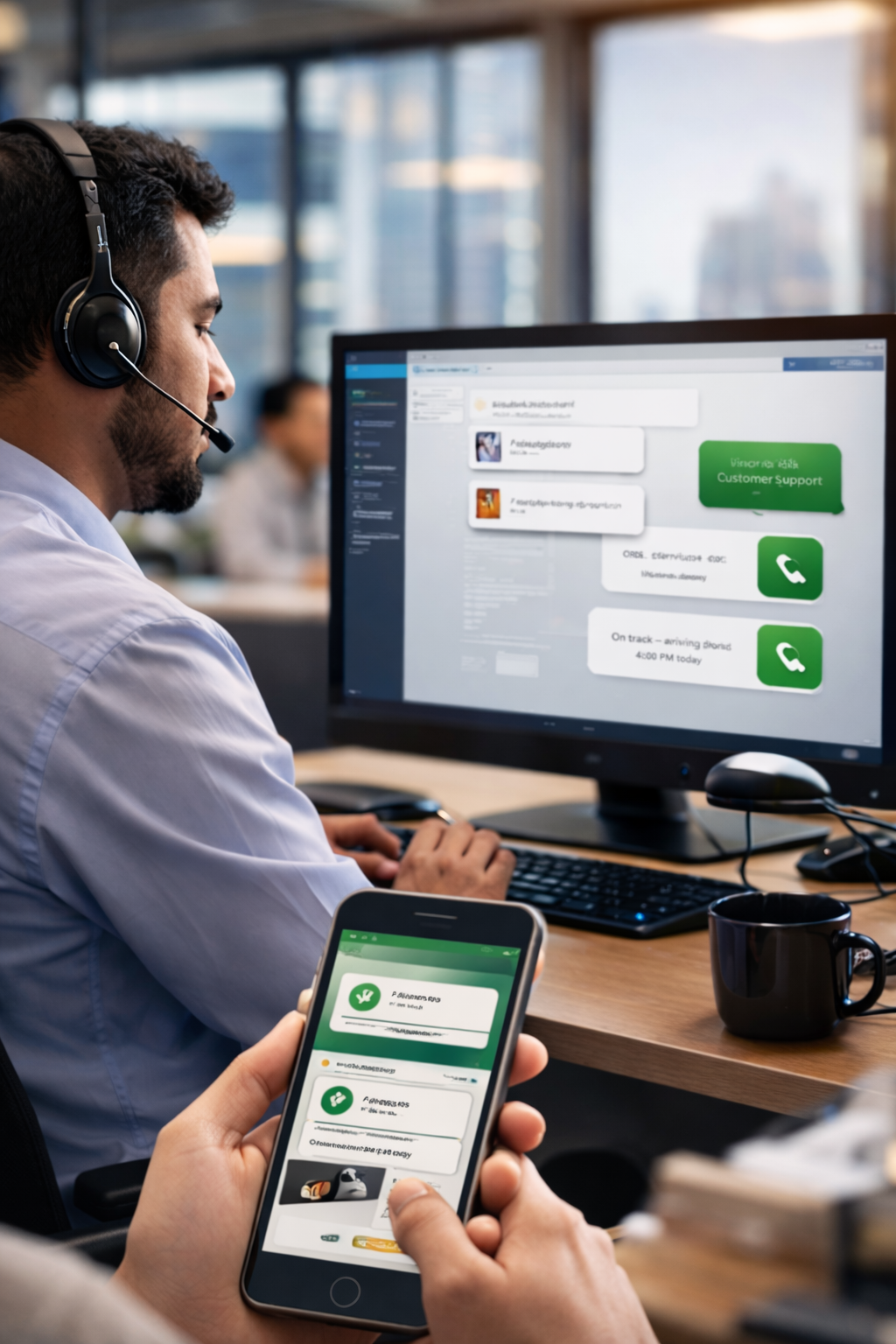
Why ecommerce in Dubai is now won or lost in conversation speed
Dubai and UAE ecommerce has become decisively mobile-first. A large share of purchase decisions now happen in short sessions on mobile, often triggered by social ads, influencer content, search, or direct product links. That means the customer is usually deciding quickly whether to continue, ask a question, or leave.
When the question comes, it is rarely abstract. It is usually about delivery timing, cash on delivery, returns, sizing, stock, authenticity, branch pickup, or whether the brand feels responsive enough to trust. In a crowded market, a slow reply is not just poor support. It is lost revenue.
That is why ecommerce AI automation Dubai brands are adopting is increasingly focused on first-response operations. The winning setup is not a generic bot layered on top of a store. It is a connected workflow across website chat, WhatsApp, order support, and human handoff.
This matters even more in 2026 because UAE shoppers expect quick delivery clarity and high service confidence. Cross-border buying, same-day or next-day expectations, and a highly competitive local ecommerce environment all push brands toward faster, more structured customer communication.
Why response speed drives ecommerce conversion in Dubai
Response speed affects conversion because pre-purchase hesitation is normal. A customer may like the product, but still pause over delivery window, payment method, product fit, or return policy. If the answer is delayed, the purchase window closes. They may compare another store, open a marketplace app, or simply postpone the decision.
In Dubai, that hesitation often happens inside messaging channels. Website chat and WhatsApp are not secondary support tools anymore. They are part of the buying journey itself. A strong WhatsApp automation for business setup helps ecommerce brands keep that conversation moving in real time.
For paid traffic especially, slow response creates hidden waste. Brands may invest heavily to generate sessions, but still lose buyers if product or delivery questions sit unanswered. This is why ecommerce customer support automation UAE teams adopt is often as much about protecting acquisition efficiency as improving service.
How AI automation reduces cart abandonment
Cart abandonment is not always a pricing problem. In Dubai ecommerce, it is often a confidence problem. The customer wants reassurance about delivery, stock, size, payment options, or return process before placing the order.
AI automation helps at that moment by keeping the conversation immediate. Instead of forcing the shopper to wait for a human reply, the system can answer approved questions, recover context from the browsing session, and nudge the customer toward checkout while intent is still high.
That makes abandoned cart recovery more practical on channels customers already use. A good flow can support reminder sequences, answer objections, and escalate high-value or repeat buyers to a human when needed. For brands handling high enquiry volume, this is where ai sales automation for online stores Dubai operators care about becomes commercially relevant.
WhatsApp automation for ecommerce brands in the UAE
WhatsApp remains one of the strongest commerce communication channels in the UAE because it feels immediate, familiar, and low-friction. Customers use it before purchase for product questions and after purchase for delivery, order status, returns, and support follow-up.
For ecommerce teams, that means WhatsApp cannot sit outside the customer journey. If the brand treats WhatsApp as an informal side channel, important conversations become fragmented. If it treats WhatsApp as part of the operating model, the channel becomes a serious conversion and service asset.
That is why whatsapp automation for ecommerce Dubai brands deploy should be built around clear workflows: product enquiry handling, cart recovery, COD clarification, payment confidence, order tracking, and escalation to a human agent when the customer needs an exception or a high-touch response.
Product recommendation, stock checks, and delivery FAQs at scale
As online catalogues expand, customers need help narrowing choices. In fashion, they ask about size and fit. In electronics, they ask about compatibility or availability. In beauty and lifestyle, they ask about bundle options, delivery timing, or what is actually in stock right now.
An ecommerce ai assistant Dubai brands use well can respond to these questions in a structured way. It can guide product discovery, surface the right item based on intent, answer approved stock or variant questions, and reduce the friction that causes customers to bounce before conversion.
Delivery clarity matters just as much. UAE shoppers often want certainty on delivery area, timing, and charges before checking out. Fast answers here build trust, especially for new brands trying to convert first-time buyers.

Order tracking, returns, and post-purchase support automation
Post-purchase communication is where many ecommerce brands lose margin and customer goodwill at the same time. Order tracking questions, return requests, delay concerns, and delivery confusion can overwhelm support teams even when the store is converting well.
Automation helps by handling repetitive questions without making the customer feel ignored. If a shopper wants to know where the order is, what the return window is, or how to start an exchange, the answer should be fast and consistent.
This is especially important in the UAE, where delivery transparency and returns clarity directly affect repeat purchase behavior. Customers are more likely to reorder when support feels reliable after payment, not just before it. That is why ecommerce order tracking chatbot Dubai use cases and return guidance flows matter beyond support efficiency alone.
Multilingual customer journeys for Dubai and UAE shoppers
Dubai ecommerce brands operate in a multilingual market by default. English is common, Arabic support matters, and many brands also serve expat-heavy audiences who expect communication to be simple and accessible. A monolingual support flow creates friction immediately.
Multilingual support is not only about translation. It is about continuity and confidence. Customers should be able to ask a question in the language they prefer, understand the next step clearly, and move through pre-sale or post-sale support without unnecessary delay.
For a multilingual ecommerce chatbot UAE brands can trust, the workflow has to be grounded in real store information and structured for handoff when a nuanced human response is needed.
UAE-specific buying behaviour ecommerce brands need to design for
Three behaviours matter consistently in the UAE market. First, browsing is strongly mobile-led, so the store experience has to support quick conversation without making the customer leave the session. Second, trust is built through fast replies, transparent delivery information, and clear payment confidence. Third, customers increasingly expect continuity on WhatsApp because it matches how they already communicate.
Returns clarity also carries more weight than many brands assume. If the customer cannot quickly understand exchange and refund expectations, purchase confidence falls. The same applies to cash on delivery, prepaid orders, shipping zones, and delivery cutoffs.
In practical terms, dubai ecommerce customer service automation works best when it handles the exact questions customers ask before and after checkout instead of trying to sound impressive. Operational clarity wins more than clever scripting.
How Chat365 helps ecommerce teams convert more conversations into revenue
Chat365 is best understood as the practical AI layer between inbound shopper questions and the team responsible for conversion or support. It helps brands respond faster on website chat and WhatsApp, capture structured intent, and reduce the support load that usually builds as order volume grows.
That includes first-response automation, customer support automation, product and delivery guidance, and smooth human handoff when a conversation becomes sensitive, high value, or operationally complex. For ecommerce operators comparing options, the Chat365 ecommerce AI assistant page shows how these workflows fit into the broader commerce use case.
If your team is also reviewing channel setup, routing, or handoff structure, the Chat365 integrations page provides a clearer view of how website chat and WhatsApp can work together.
What ecommerce brands should prioritise in 2026
The priority is not “more AI.” It is better conversation design. Ecommerce brands in Dubai and the UAE should focus on faster first response, clear delivery and returns communication, multilingual handling, and better coordination between store operations and customer support.
They should also look at where conversations are being lost today. Usually it is around pre-purchase questions, payment hesitation, cart abandonment, order visibility, or delayed follow-up on WhatsApp. Those are the points where automation can create measurable commercial impact.
Teams that prioritise these areas will be better positioned for 2026 growth than teams that only add more acquisition channels without improving the customer communication layer behind them.
Conclusion
Dubai ecommerce in 2026 will reward brands that respond faster, communicate more clearly, and support customers across website chat and WhatsApp without adding unnecessary operational friction. If you are evaluating a more practical approach to ecommerce ai automation dubai use cases, explore Chat365 for ecommerce automation in Dubai and the UAE.
Related reading
See more sector-specific automation ideas on the Chat365 blog, compare with retail automation in Dubai, or review how other sectors approach faster response on the healthcare automation blog.
Book a demo with Chat365 if you want to evaluate a practical AI layer for ecommerce conversations, support automation, and revenue recovery.