Why Traditional HR Models Are Breaking Under Modern Hiring Pressure
Recruitment and HR operations across Dubai and global markets are undergoing a structural shift. The increasing volume of applicants, hybrid workforce models, and demand for faster hiring cycles have exposed the inefficiencies of traditional HR processes. Manual resume screening, delayed interview coordination, and fragmented communication channels are no longer sustainable in a market where top talent is secured within days, not weeks.
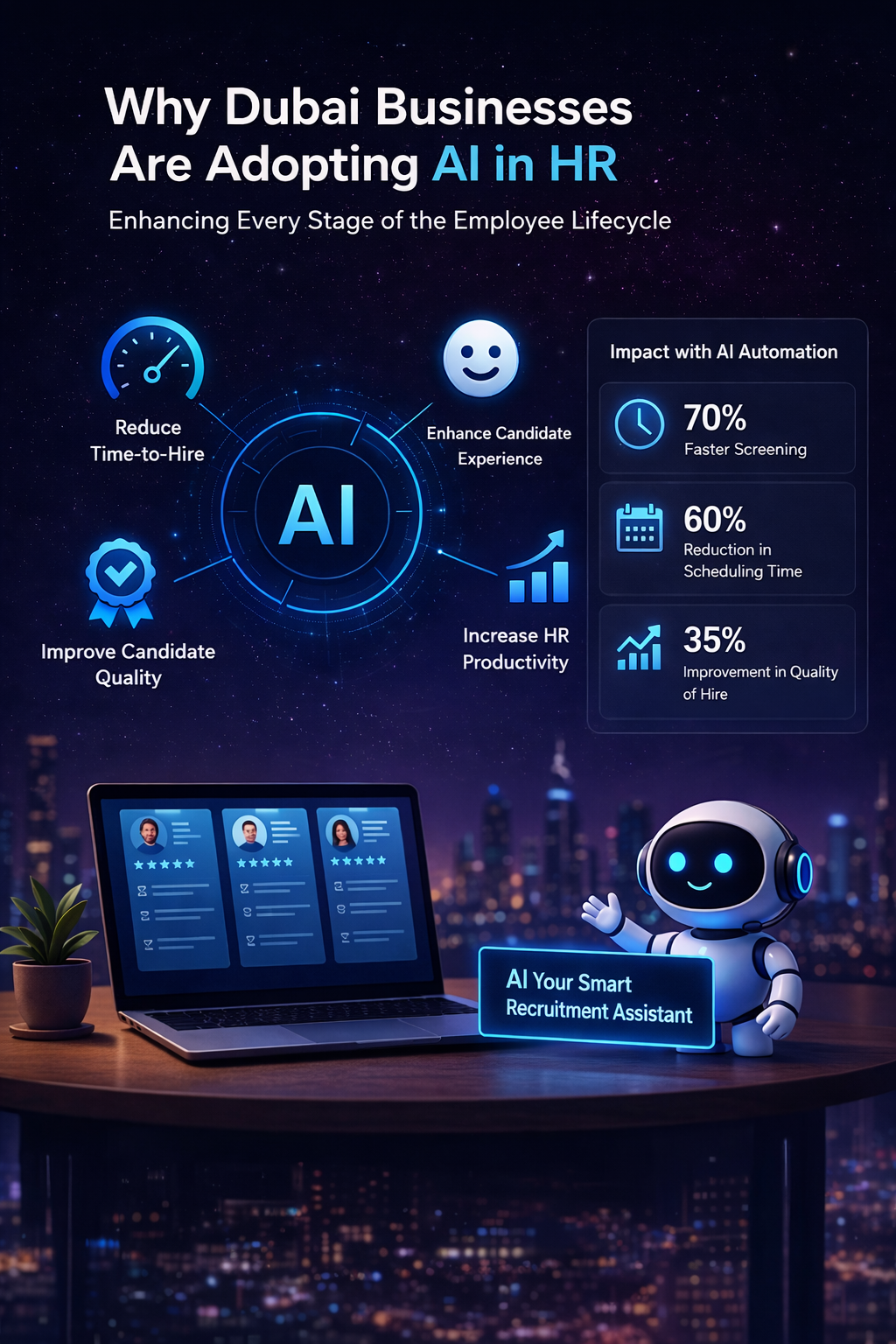
Organizations are now under pressure to reduce time-to-hire while improving candidate quality and experience simultaneously. This dual expectation has accelerated the adoption of AI-powered recruitment automation, particularly conversational AI deployed across websites and WhatsApp. Businesses are no longer asking whether to automate HR workflows. They are evaluating how quickly they can implement it without disrupting existing systems.
The Rise of AI Chatbots in Recruitment: From Screening to Smart Hiring Decisions
AI chatbots in recruitment are no longer limited to answering basic HR queries. They are now acting as intelligent recruitment assistants capable of handling end-to-end hiring workflows. From candidate pre-screening based on skills and experience to automated interview scheduling, AI is enabling HR teams to operate with speed and precision.
An AI-powered system can instantly analyze resumes, extract relevant data, and match candidates to job roles using predefined criteria. This eliminates the initial manual filtering stage, which traditionally consumes a significant portion of HR bandwidth. At the same time, conversational bots engage candidates in real time, ensuring no delay in communication, one of the biggest drop-off points in recruitment funnels.
This aligns with broader industry findings that AI-driven automation improves efficiency, reduces administrative burden, and allows HR professionals to focus on strategic decision-making rather than repetitive tasks.
Intelligent Candidate Pre-Screening: Moving Beyond Keyword Matching
One of the most impactful use cases in modern HR automation is AI-driven candidate pre-screening. Unlike traditional Applicant Tracking Systems that rely heavily on keyword matching, AI chatbots evaluate contextual relevance, experience depth, and role alignment.
Candidates can interact with a chatbot that dynamically asks qualification questions, assesses responses, and ranks applicants in real time. This creates a more accurate and bias-reduced screening process while significantly shortening the hiring cycle. In competitive hiring markets like Dubai, where speed is critical, this capability directly impacts business outcomes.
Automated Interview Scheduling: Eliminating Bottlenecks in Hiring Pipelines
Interview coordination has historically been one of the most time-consuming aspects of recruitment. Back-and-forth emails, availability conflicts, and missed follow-ups often delay the process and negatively impact candidate experience.
AI automation resolves this by synchronizing calendars, offering real-time scheduling options, and confirming interview slots instantly. Candidates can select preferred time slots through a chatbot interface, while the system automatically updates internal calendars and sends reminders. This not only accelerates the hiring process but also projects a more professional and responsive employer brand.
Resume Parsing and Job Matching: Building Data-Driven Hiring Engines
Modern AI systems are capable of extracting structured data from resumes and matching candidates with open roles based on multiple parameters, including skills, experience, and behavioral indicators. This transforms recruitment from a reactive process into a predictive one.
Instead of manually reviewing applications, HR teams receive a shortlist of highly relevant candidates ranked by fit. This improves hiring accuracy and reduces dependency on subjective decision-making. Over time, AI systems also learn from hiring outcomes, continuously refining their matching algorithms.
Employee Experience Automation: From Onboarding to Internal Communication
Recruitment is only one part of the HR lifecycle. AI chatbots are increasingly being used to enhance the employee experience post-hiring. From answering policy-related queries to guiding employees through onboarding processes, AI ensures consistent and instant support.
Employees can access HR information, request documents, or clarify policies without waiting for manual intervention. This creates a more responsive and employee-centric HR environment, which is critical for retention in competitive job markets.
Additionally, AI-driven internal job posting alerts and career progression recommendations help organizations retain talent by improving internal mobility.
Exit Interviews and Workforce Insights: Turning Feedback into Strategy
Exit interviews are often underutilized due to lack of structured processes. AI chatbots can automate exit data collection, ensuring higher response rates and more honest feedback.
This data, when analyzed using AI, provides actionable insights into employee turnover, organizational gaps, and cultural challenges. HR leaders can then use these insights to improve retention strategies, refine hiring practices, and enhance overall workforce planning.
AI-powered analytics is increasingly becoming a cornerstone of modern HR, enabling organizations to identify trends, predict employee behavior, and make data-backed decisions.
Virtual AI Assistants for HR: The Shift Toward Always-On Recruitment
The concept of a virtual HR assistant is gaining traction, especially in digitally advanced markets like the UAE. These assistants operate 24/7 across platforms such as websites and WhatsApp, ensuring continuous engagement with candidates and employees.
Whether it is conducting initial interview rounds, answering FAQs, or guiding candidates through application processes, virtual assistants eliminate delays and improve accessibility. This always-on capability is becoming a competitive differentiator for organizations aiming to attract top talent.
Critical Market Analysis: Challenges and Opportunities in AI Recruitment Adoption
Despite rapid adoption, AI in recruitment is not without challenges. Concerns around data privacy, algorithmic bias, and integration with legacy HR systems remain significant barriers. Organizations must ensure that AI systems are transparent, compliant with regulations, and continuously monitored for fairness.
However, the opportunity outweighs the risk. Companies that successfully implement AI-driven HR automation are experiencing reduced hiring costs, improved candidate experience, and faster decision-making cycles. In markets like Dubai, where digital transformation is a strategic priority, early adopters are already gaining a competitive edge.
The shift is clear: HR is evolving from an administrative function to a strategic business driver powered by AI.
The Future of Recruitment & HR in Dubai: AI as a Core Infrastructure
Looking ahead, AI will not be an add-on to HR systems. It will become the foundation. Hyperautomation, predictive hiring models, and personalized employee experiences will define the next phase of HR transformation.
Organizations that invest in AI-powered recruitment today are not just optimizing processes. They are building scalable, future-ready workforce systems. As competition for talent intensifies, the ability to respond instantly, analyze intelligently, and engage continuously will determine hiring success.
Transform Your HR Operations with AI-Powered Recruitment Automation
AI recruitment chatbots are no longer a futuristic concept. They are a present-day necessity. From candidate screening to employee engagement, AI is redefining how organizations manage their workforce.
For businesses in Dubai and beyond, adopting AI-powered HR automation is not just about efficiency. It is about staying competitive in a rapidly evolving talent landscape. To see how this connects to the broader product offering, explore the Chat365 recruitment and HR page.